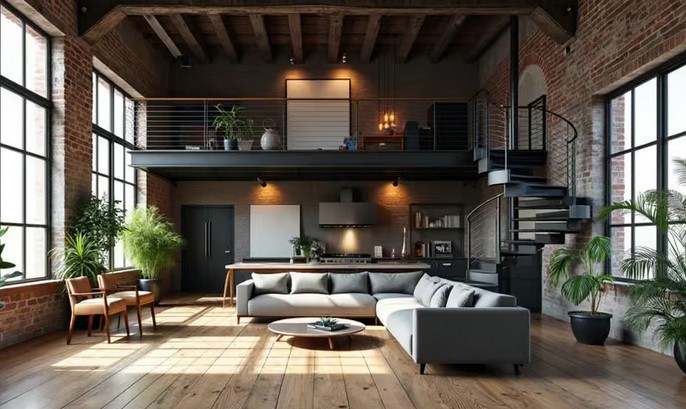
I remember walking into a “modern” downtown penthouse last year—think floor-to-ceiling glass, stark white walls, and a polished concrete floor that looked so cold it made me shiver just looking at it. It was technically perfect, but it felt like living inside a computer. The homeowner told me, “I love the space, but it has no soul.”
Ten minutes later, we were discussing the installation of a rustic wood beam right across the center of the living area. It wasn’t about supporting the roof; it was about injecting history and warmth into a room that felt too sterile to be a home.
In my ten years of managing home improvement projects, I’ve found that the best modern designs aren’t the ones that are purely minimalist—they’re the ones that balance the “new” with the “lived-in.” A rustic wood beam is the bridge between those two worlds.
Why Modern Architecture Craves Ancient Wood
Think of your home’s design like a well-balanced meal. Modern design often provides the “acid”—it’s sharp, bright, and clean. But without the “fat” or the “earthiness,” it feels unfinished. A rustic wood beam provides that grounding, organic weight that prevents a modern home from feeling like a sterile laboratory.
When we integrate these elements, we aren’t just adding wood; we are adding a texture that carries the marks of time. In high-end design, we call this “Patina.” It’s the visual evidence of character that you simply cannot manufacture with synthetic materials.
The Technical Reality: Solid Timber vs. Faux Box Beams
Before you start planning your layout, there’s a crucial technical distinction you need to understand. Not every “beam” you see in a luxury magazine is a massive, structural piece of oak.
-
Solid Timber Beams: These are heavy, authentic, and often require structural engineers to sign off on your ceiling joists. They are magnificent, but they are expensive and logistically demanding.
-
Faux Box Beams (The Expert’s Secret): Most of the beams I install in high-end projects are actually “hollow” boxes made of reclaimed wood planks. They are lightweight, allow you to hide electrical wiring or HVAC ductwork inside, and are much easier to install.
Strategic Placement: Creating Visual Flow
If you place a rustic wood beam randomly, it will look like a mistake. If you place it strategically, it becomes a roadmap for the eye.
1. The Zoning Effect
Use a beam to delineate an open-concept space. If your kitchen flows directly into your living room, placing a beam at the transition point acts as a “soft wall” that separates the areas without blocking the natural light.
2. Highlighting Architectural Features
If you have a beautiful stone fireplace or a custom range hood, a single well-placed beam can act as a visual frame, drawing the viewer’s eye directly to your focal point.
3. Creating Ceiling Height Illusion
By installing beams in a grid pattern on a flat ceiling, you add depth. Even though you are technically lowering the “visual ceiling,” the added dimension creates a sense of luxury that makes a room feel more intentional and “wrapped.”
Installation Precision: Avoiding the “Drift”
You might think that because a beam looks “rustic,” the installation can be sloppy. Quite the opposite. Because these beams are dark and bold, any gap between the beam and the ceiling is magnified.
-
The Scribe Method: Use a contour gauge to “scribe” the shape of your ceiling onto the ends of the beam. If your ceiling isn’t perfectly flat (and it never is), you need to cut the wood to match the ceiling’s imperfections.
-
Securing the “Blocking”: For box beams, we use a system of “cleats”—wood strips screwed into the ceiling joists. The beam is then slid over the cleat and nailed from the side. This is invisible, secure, and rock-solid.
Expert Advice: The Hidden Dangers of Reclaimed Wood
I’ve seen a lot of DIYers order reclaimed wood online and have a complete disaster on their hands. Here are the “hidden” warnings from the field:
Pest Control: Reclaimed timber comes from barns, old factories, and warehouses. If it hasn’t been kiln-dried or professionally fumigated, you are literally bringing bugs into your house. Always demand a certificate of heat treatment.
Thermal Expansion: Even “old” wood reacts to the humidity in your home. If you install a solid beam in the middle of a dry winter, it will shrink and crack by mid-summer. Always let the wood “acclimate” in your home for at least 72 hours before installation.
Selecting the Finish: Keeping it High-End
The difference between a “craftsman” look and a “cheap” look often comes down to the finish.
-
Avoid Thick Varnish: A glossy, orange-tinted polyurethane will make a reclaimed beam look like plastic.
-
Go for Matte Oils: Use a hard-wax oil (like Rubio Monocoat). It keeps the wood looking raw and authentic while providing protection against dust and moisture. It allows the grain to speak for itself.
Modern Design Harmony: The Color Palette
When you introduce a rustic wood beam, you are introducing a dominant color. You must balance this with your modern palette:
-
The Contrast Rule: If your walls are a crisp, cool white, choose a darker, richer beam (like toasted oak or walnut).
-
The Tone-on-Tone Rule: If your home uses a lot of warm beige or greige, choose a lighter, bleached-wood beam (like white oak or pine) to keep the look sophisticated and cohesive.
Elevating the Space with Subtle Lighting
One of the best technical tricks I’ve learned is integrating low-voltage LED channels along the top edge of a box beam. By “up-lighting” the ceiling, you highlight the texture of the beam while creating a soft, ambient glow that reflects off the ceiling, making the room feel larger and more expensive.
Incorporating a rustic wood beam into a high-end modern design isn’t about “country living.” It’s about balance. It’s about taking the sharp edges of modern architecture and softening them with the warm, weathered touch of history.
When you get the scale, the finish, and the installation right, you create a space that feels timeless. You aren’t just building a house; you’re building an environment that feels like it’s been there for years, yet has the convenience of today.
Are you currently looking at a “cold” space that needs some character? I’d be happy to help you figure out the scale and wood species that would best fit your ceiling height and room proportions. Would you like me to guide you through the process of choosing between a solid beam and a faux box beam?