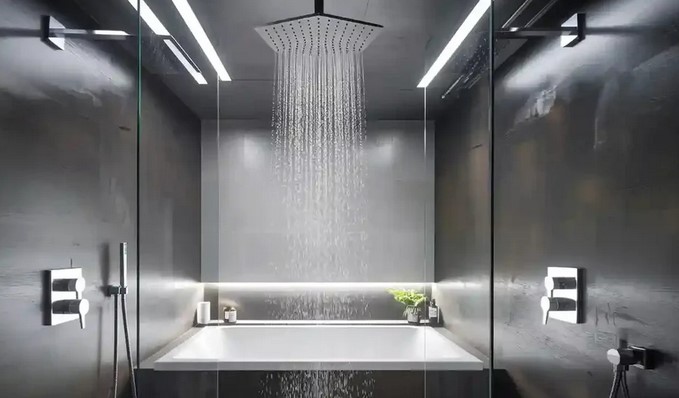
Imagine standing in a five-star spa in Bali, the world slowing down as a gentle, high-volume deluge of water washes away a week’s worth of stress. Now, imagine trying to recreate that at home, only to end up with a pathetic, high-pressure needle spray that feels more like being poked by tiny frozen toothpicks than standing in a tropical storm.
In my decade of tearing down master baths and consulting on high-end residential plumbing, I’ve realized one thing: most people buy a rain showerhead because of how it looks on the showroom wall, not how it handles fluid dynamics. If you’ve ever installed one only to be disappointed by “wimpy” water pressure, you aren’t alone.
Understanding how to bridge the gap between a “leaky faucet” feel and a true “monsoon” experience requires a deep dive into flow rates, gravity, and the physics of the nozzle itself.
The Physics of the Plunge: How a Rain Showerhead Actually Works
Most standard showerheads are designed to compress water into a narrow, high-velocity stream to blast dirt off your skin. A true rain showerhead, however, is an exercise in flow distribution.
Think of it like a garden hose versus a watering can. The hose (standard showerhead) uses pressure to travel distance. The watering can (rain head) uses a wide surface area and gravity to create a “falling” sensation.
Pressure vs. Flow: The Great Misconception
In the plumbing world, we distinguish between PSI (Pounds per Square Inch) and GPM (Gallons Per Minute).
-
PSI is the “push” behind the water.
-
GPM is the actual volume of water moving through the pipe.
To get that luxurious feel, you don’t actually want more pressure; you want more volume distributed evenly. This is where “Air Induction” technology comes into play—a secret weapon in modern fixture design.
Advanced Flow Dynamics: Why Air Induction Changes Everything
One of the most common complaints I hear is: “My rain showerhead feels weak.” This usually happens because the homeowner has 8-inch diameter showerhead but only 45 PSI of water pressure.
To combat this, premium brands use Venturi effect nozzles. By injecting air into the water stream, the fixture creates larger, “fat” droplets that feel heavier on the skin without actually using more water.
The Benefits of Aerated Flow:
-
Heat Retention: Larger droplets hold their temperature longer as they fall through the air.
-
Sensory Perception: The air-water mix creates a “bubbling” sensation that mimics the weight of natural rain.
-
Efficiency: You can achieve a high-end feel while staying within the standard 2.5 GPM federal limit.
Critical Installation Factors for Maximum Uptime and Wellness
I once had a client who spent $1,200 on a solid brass rain head, only to have it drip like a sad umbrella. The culprit? He used a standard 1/2-inch supply line that was shared with the toilet.
1. Ceiling Mount vs. Wall Arm
To truly experience flow dynamics, the water should fall at a 90-degree angle to your shoulders.
-
Ceiling Mount: Provides the most immersive experience but requires “dropping” the plumbing through the ceiling.
-
Extended Wall Arm: A “J-arm” or “S-arm” can raise the height, but if the arm is too long and thin, you lose the velocity needed to keep the nozzles clear of mineral buildup.
2. The Leveling Trap
If your rain showerhead isn’t perfectly level, water will pool on one side of the internal chamber. This leads to uneven “weeping” where some nozzles fire and others just drip. Always use a spirit level during the final tightening of the shower arm.
Navigating Materials: Beyond the Chrome Finish
In my 10 years of experience, I’ve seen more “bargain” showerheads fail due to galvanic corrosion than anything else. When you mix a cheap zinc showerhead with a copper pipe, they essentially create a tiny battery that eats the metal from the inside out.
-
Solid Brass: The gold standard. It’s heavy, handles heat perfectly, and will likely outlive your house.
-
304 Stainless Steel: Excellent for modern, thin-profile “wafer” heads. It resists lime-scale better than almost anything else.
-
Silicone Nozzles: This is a non-negotiable for me. Rub-clean nozzles allow you to flick away calcium deposits with your finger, preventing the “crooked spray” that ruins the rain effect.
Expert Advice: The Hidden Warning for Older Homes
Here is a “Pro Tip” you won’t find in the DIY manual: Check your water heater capacity before going big. A large-format rain showerhead (12 inches or wider) consumes a lot of hot water very quickly. If you have an old 30-gallon tank and you install a high-flow rain head, your “wellness retreat” will turn into a “Polar Plunge” in about seven minutes.
Scannable Checklist: Is a Rain Head Right for Your Bathroom?
-
Ceiling Height: Do you have at least 84 inches of clearance?
-
Water Pressure: Is your home’s PSI at least 50? (If not, look for an Air-Induction model).
-
Drainage: Can your floor drain handle a high volume of water without pooling?
-
Valve Compatibility: Do you have a Pressure-Balancing Valve to prevent “shower shock” when someone flushes the toilet?
Maintenance for Longevity: The Vinegar Soak
Even the best fixtures need love. Once a year, I tell my clients to tie a plastic bag filled with distilled white vinegar over the showerhead and let it sit overnight. This dissolves the “invisible” scale inside the flow restrictor, restoring that day-one monsoon feeling without a single tool.
Conclusion: Making the Rain Work for You
Upgrading to a rain showerhead is more than just a cosmetic swap; it’s an investment in your daily mental health. By understanding the balance between GPM volume, nozzle engineering, and proper positioning, you move from a basic bathroom to a residential sanctuary.
Don’t settle for a weak drizzle. Look for fixtures that prioritize air-induction and solid brass construction to ensure your “wellness flow” remains uninterrupted for years to come.
Are you planning a bathroom remodel, or are you just looking to swap out your current head for something more luxurious? Tell me about your current water pressure situation in the comments—I’d love to help you spec the right model!