It’s Thanksgiving afternoon, and the kitchen is a war zone. You’ve spent twelve hours prepping the bird, your guests are clinking glasses in the living room, and the pressure is mounting. You pull the turkey out, guess that it “looks done” because the skin is golden-brown, and carve into it—only to find pink, translucent juices running across the board. Or worse, you’ve cooked it so long it has the structural integrity of a piece of dry drywall.
In my decade of consulting on high-end kitchen remodels and home infrastructure, I’ve seen homeowners spend $10,000 on a professional-grade range, only to “eyeball” their cooking. According to the CDC, roughly 48 million people get sick from foodborne illnesses every year. Most of those cases start in the home kitchen.
I’ve learned the hard way that a meat thermometer digital isn’t just a kitchen gadget; it is a critical safety sensor. If you wouldn’t build a house without a level, you shouldn’t cook a meal without a precision probe.
The Physics of Thermal Carry-Over: Why Seconds Matter
In home improvement, we talk about “thermal mass”—how a brick wall holds heat long after the sun goes down. Meat behaves exactly the same way. When you take a steak off the grill, it doesn’t stop cooking. The exterior is much hotter than the interior, and that heat continues to migrate toward the center.
Think of your steak like a hot water pipe. Even after you turn off the valve (take it off the heat), there is still water (heat) in the line that needs to finish flowing through the system. This is called Carry-over Cooking.
Without a meat thermometer digital, you are flying blind. You might take a roast out at 165°F (74°C), but ten minutes later, that internal temperature has climbed to 175°F (79°C), turning a succulent meal into leather.
Choosing Your Sensor: Instant-Read vs. Leave-In Probes
Not all thermometers are created equal. In my professional kit, I categorize them based on their “Latency”—how fast they can give you a true reading.
1. Thermocouple (Instant-Read)
This is the “Formula 1” of the meat thermometer digital world. It uses two different metals in the tip to create an electrical current that changes with temperature.
-
Speed: 1 to 3 seconds.
-
Best For: Checking multiple pieces of chicken on a grill or finding the “cool spot” in a large roast.
2. Thermistor (Leave-In/Wireless)
These are the sensors I recommend for “Low and Slow” operations like smoking a brisket or roasting a prime rib.
-
The Benefit: You don’t have to keep opening the oven door.
-
Insight: Every time you open that oven door to check the meat, you lose about 25°F of ambient heat. A leave-in probe ensures your oven’s “envelope” stays sealed and efficient.
Strategic Placement: The “Cold Point” Engineering
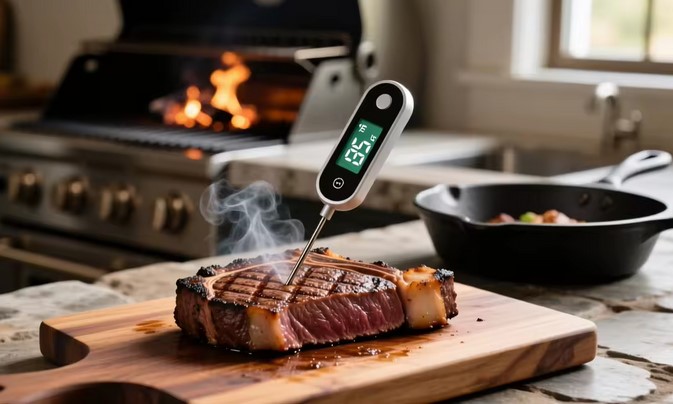
The most common mistake I see is “User Placement Error.” If you hit a bone or a pocket of fat, your meat thermometer digital will give you a false positive.
The Pro-Grip Technique:
-
Avoid the Bone: Bone conducts heat faster than muscle. If your probe touches the bone, it might read 165°F while the meat around it is still a dangerous 145°F.
-
The Thermal Center: Aim for the thickest part of the muscle, furthest from the surface.
-
Angle of Entry: For thin items like burgers or fish fillets, insert the probe sideways through the edge. This ensures the sensor (which is usually in the last 1/4 inch of the tip) is fully submerged in the meat.
Technical Maintenance: Calibration and Cross-Contamination
A thermometer is only as good as its last calibration. If your sensor is off by even 3 degrees, you are no longer in “Food Safety Compliance.”
The Ice Bath Test (32°F / 0°C)
I perform this test every three months, just like I check the batteries in my smoke detectors. Fill a glass with crushed ice and just enough water to fill the gaps. Stir it and let it sit for 2 minutes. Insert your meat thermometer digital. It should read exactly 32°F (0°C). If it doesn’t, most digital models have a “Cal” button to reset the baseline.
Cross-Contamination Protocol
In the field, we talk about “clean sites” and “dirty sites.” If you poke a raw chicken at the 20-minute mark and then poke it again when it’s done without sanitizing the probe, you’ve just moved Salmonella from the raw center to the cooked surface. Always wipe your probe with an alcohol swab or hot soapy water between every single reading.
Expert Advice: The “Resting” Threshold
Most beginners think “Safe Temperature” means “Temperature when I take it out.” This is incorrect. To maximize juice retention, you must allow for a Resting Period.
Tips Pro: Pull your meat 5°F (3°C) BEFORE your target temperature. For a medium-rare steak (Target: 135°F), pull it at 130°F. The carry-over heat will bring it to the perfect “Done” state while the muscle fibers relax and reabsorb the juices.
Scannable Safety Checklist: Target Temperatures (USDA Standards)
-
Poultry: 165°F (74°C) – No exceptions.
-
Ground Meats: 160°F (71°C) – Critical because bacteria is mixed throughout the meat.
-
Pork/Beef Steaks: 145°F (63°C) + 3-minute rest.
-
Fish: 145°F (63°C) or until opaque.
Advanced Features: Bluetooth and App Integration
For the tech-savvy homeowner, modern meat thermometer digital systems now sync with your smartphone. You can set “High-Heat” and “Low-Heat” alerts. This is essentially Home Automation for your dinner. If your grill flares up or your oven shuts off, your phone will buzz. This level of monitoring ensures that you aren’t just cooking; you are managing a controlled thermal environment.
Conclusion: Accuracy Over Intuition
Elevating your home cooking isn’t about fancy recipes; it’s about Precision Monitoring. By integrating a meat thermometer digital into your routine, you move from the uncertainty of “I think it’s done” to the confidence of “I know it’s safe.”
Treat your kitchen like the high-performance environment it is. Invest in a quality sensor, calibrate it often, and respect the laws of thermodynamics. Your family’s health—and the quality of your Sunday roast—depend on it.
Are you still using the “finger-poke” test to check your steaks, or have you made the switch to digital precision? Tell me about your most stressful holiday cooking moment in the comments below!