 Over my ten years in the home improvement trenches, I’ve walked into hundreds of residential garages. More often than not, I’m greeted by the same sight: a dreary, oil-stained concrete cavern illuminated by a single buzzing fluorescent bulb. It’s a wasted opportunity.
Many homeowners treat the garage as a forgotten storage locker, but it’s actually the largest underserved canvas in your home. Choosing the right garage paint color isn’t just about making the space look clean; it’s about mastering industrial aesthetics to transform a chaotic workshop into a sleek, high-functioning extension of your living space.
Let’s dive into how you can strategically use color theory, lighting physics, and the right coatings to optimize your garage.
Why Garage Paint Color Dictates the Entire Mood
Think of your garage walls as the background canvas of a high-end studio. If you leave them clad in bare, taped drywall or a fading coat of builder-grade white, every tool rack, storage bin, and vehicle will look like clutter. A strategic color palette binds these chaotic elements together into a cohesive, industrial design statement.
The Psychology of Industrial Design
Industrial aesthetics thrive on functionality, raw textures, and deliberate color choices. In my experience, the right garage paint color can make a low-ceilinged two-car garage feel like an expansive automotive gallery. Conversely, the wrong choice can make a spacious three-car garage feel like a claustrophobic commercial dungeon.
Light Reflectance Value (LRV) Matters
In the home improvement world, we rely heavily on a metric called Light Reflectance Value (LRV). LRV is measured on a scale from 0% (absolute black, absorbing all light) to 100% (pure white, reflecting all light).
In a garage, where natural light is usually scarce, understanding LRV is your superpower. If you paint your walls in a trendy, ultra-dark charcoal with an LRV of 12%, you will essentially turn your workspace into a cave, requiring massive amounts of artificial lumen output just to find a dropped philips screwdriver.
The Strategic Palette: Choosing Your Core Hue
When advising clients, I break down the selection process into three distinct industrial design directions. Your choice depends on how you actively use the space.
+-----------------------------------------------------------------------+
|                       GARAGE COLOR STRATEGIES                         |
+---------------------------+-------------------------------------------+
| Sleek & Modern (Grays)    | Hides grime, maximizes industrial vibe    |
+---------------------------+-------------------------------------------+
| Bold & High-Octane        | Creates energy, perfect for workshops     |
+---------------------------+-------------------------------------------+
| Warm Industrial (Earth)   | Softens the space for multi-use gyms      |
+---------------------------+-------------------------------------------+
1. The Cool Industry: Shades of Gray
You can never go wrong with gray, but the secret lies in the undertones.
-
Light Gray (LRV 50-60%): This is the sweet spot for 90% of homeowners. It reflects enough light to keep the workspace functional while masking drywall imperfections and minor dust.
-
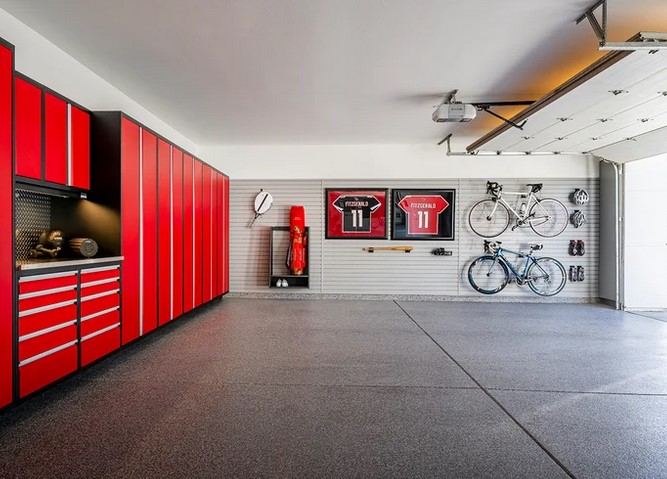
Battleship Gray or Charcoal: These deeper hues create a stunning, high-contrast backdrop if you have bright red or white tool chests. However, keep these dark tones restricted to an accent wall unless you have abundant LED overhead grid lighting.
2. The High-Octane Workspace: Bold Accents
If your garage is a sanctuary for classic car restoration or heavy woodworking, don’t be afraid of high-saturation colors. A deep royal blue, a muted racing green, or even a fiery crimson can be utilized strategically.
Pro Tip: Don’t paint all four walls a vibrant red—it will raise your blood pressure within twenty minutes. Instead, use a bold color on the wall anchoring your main workbench, and frame it with neutral tones on the remaining walls.
3. The Warm Minimalist: Earthy Industrial
If your garage pulls double duty as a home gym or a laundry station, look toward warm neutrals. Greige (a blend of gray and beige) or a soft, muted khaki offers a softer take on the industrial look. It pairs beautifully with black matte metal shelving units and exposed wooden ceiling beams.
Technical Specifications: It’s Not Just the Color, It’s the Chemistry
I’ve seen brilliant color choices completely ruined because the homeowner used standard interior latex bedroom paint on a garage wall. Garages are harsh environments prone to extreme temperature swings, humidity, and chemical vapors.
Demanding the Right Finish
-
Flat/Matte: Avoid this at all costs. Flat paint acts like a sponge for airborne oil mist and fingerprints. You will never be able to wipe it clean.
-
Satin: A highly acceptable choice for walls with minor dings and dents, as it offers decent washability without highlighting structural flaws.
-
Semi-Gloss: The industry gold standard. Semi-gloss finishes provide a tight polymer shield that repels moisture, soot, and mud. Plus, its reflective sheen bounces light efficiently around the room.
Formulations to Look For
When shopping at your local paint center, look for premium exterior acrylic latex or specialized interior/exterior anti-microbial formulas. These contain higher solid contents and superior binders that resist the scuffing caused by leaning bicycles, lawnmowers, and ladders against the wall.
The Perfect Match: Coordinating Walls with Your Garage Floor
Your walls do not exist in a vacuum. To achieve true industrial optimization, your garage paint color must seamlessly coordinate with your floor coating, whether it is raw concrete, a polyaspartic system, or interlocking modular tiles.
          [ Wall Color ]  <--->  [ Floor Coating ]
                |                     |
                v                     v
          (Semi-Gloss Gray)      (Dark Epoxy Flake)
If you have a dark grey epoxy floor with color flakes, balance the vertical space by painting your walls a crisp, light silver-gray. If your floor is a light, natural concrete finish, you have the freedom to go darker on the walls to anchor the room.
Step-by-Step Blueprint for a Flawless Application
Before you crack open a single can of paint, remember this fundamental rule of home improvement: 80% of the quality lies in the preparation.
-
Deep Cleansing: Garage walls accumulate a microscopic layer of exhaust soot and dust. Wash the walls thoroughly with a solution of Tri-Sodium Phosphate (TSP) and warm water to strip away grease.
-
Addressing the Moisture: Check the lower perimeter of your drywall for signs of water efflorescence or molding. Address any structural leaks before sealing the wall.
-
The Primer Lockdown: Raw drywall or previously glossy walls require a high-quality, stain-blocking bonding primer. This ensures your final color goes on uniformly without absorbing unevenly into the substrate.
-
Cut In and Roll: Use a heavy-duty 3/8-inch or 1/2-inch nap roller sleeve to navigate the textured surface of garage drywall or masonry blocks smoothly.
Hidden Warnings: Avoid These Amateur Mistakes
⚠️ The Hot Tire Pickup Phenom
While this guide focuses primarily on walls, if you decide to extend your color scheme to the floor, never use cheap “garage floor paint.” The heat generated by your car tires after a long drive will literally melt the cheap acrylic binders, causing the paint to peel off the concrete and stick to your tires the next time you back out. Always opt for a two-part aliphatic epoxy or a polyaspartic kit.
-
Ignoring the Ceiling: Don’t leave your ceiling a patchy, unpainted mess. To maintain that bright, airy industrial feel, paint the ceiling a stark, bright flat white. This maximizes the downward dispersion of light from your fixtures.
-
Testing Under the Wrong Bulbs: Never pick a color based solely on how it looks under store lighting. Bring sample swatches home and view them inside your garage with the garage door fully open (daylight) and fully closed (artificial light).
Conclusion: Transform Your Domain
Optimizing your garage with a strategic garage paint color is one of the most cost-effective weekend projects you can undertake. By understanding Light Reflectance Value, selecting a resilient semi-gloss finish, and coordinating your tones with your flooring, you elevate the garage from a mere utility closet to an architectural showcase.
Now, I want to hear from you. What does your current garage setup look like, and which color palette are you leaning toward to take it to the next level? Drop your thoughts, questions, or project challenges in the comments below!