Imagine this: You’ve just spent thousands of dollars on a gorgeous, book-matched marble vanity countertop. The tile work is flawless, and the lighting is picture-perfect. But the very first time you wash your hands, water aggressively splashes all over your sleeves, pools around the base of the basin, and slowly drips onto your brand-new hardwood floors.
In my ten years of tearing down and rebuilding bathrooms, I’ve seen this exact heartbreak happen more times than I can count. Homeowners treat the bathroom sink faucet as an afterthought—a minor jewelry piece chosen solely by its shiny finish at the local home center.
In reality, the faucet is the absolute hard worker of your sanitary space. It is the bridge between raw plumbing utility and high-end interior architecture. Let’s look at how to strategically select and integrate this crucial fixture to elevate your bathroom design without causing a plumbing disaster.
The Anatomy of Flow: Why More Than Aesthetics Matter
When you look at a bathroom sink faucet, you might just see a spout and a handle. When I look at it, I see water pressure dynamics, valve composition, and ergonomic clearance. Choosing the wrong combination is like putting a massive V8 engine inside a tiny golf cart; it simply won’t function harmoniously.
Understanding the Mechanics
A high-performing fixture relies heavily on what’s inside the metal casing. Modern high-quality faucets utilize ceramic disc cartridges instead of old-school rubber washers. These ceramic discs are diamond-hard and diamond-smooth, moving against each other to cut off water flow with absolute precision, virtually eliminating the dreaded midnight drip.
The Spout Reach and Height Equation
To avoid the splashing disaster mentioned earlier, you must calculate the relationship between your faucet and the basin.
-
The Aerator Placement: The point where water exits the faucet should ideally line up directly over the drain hole, or slightly behind it.
-
Vessel Sinks vs. Undermount Sinks: An undermount sink allows you to use a standard-height spout. However, if you opt for a trendy above-counter vessel sink, you will need a tall vessel tower or a wall-mounted unit to clear the rim safely.
Selecting Your Configuration: Matching Hole Layouts to Your Vision
Before falling in love with a specific matte black or brushed brass finish, you need to know what your sink or countertop can actually accommodate.
+-----------------------------------------------------------------------+
|                       FAUCET CONFIGURATION GUIDE                      |
+---------------------------+-------------------------------------------+
| Single-Hole               | Minimalist, easy to clean, single lever   |
+---------------------------+-------------------------------------------+
| Center-Set (4-inch)       | Traditional, compact, deck-plate bound    |
+---------------------------+-------------------------------------------+
| Widespread (8-inch)       | Luxurious, flexible placement, dual valve |
+---------------------------+-------------------------------------------+
1. The Single-Hole Modernist
The single-hole bathroom sink faucet is the darling of contemporary design. It combines the spout and the mixing lever into one compact body. It requires only one hole drilled into your vanity deck, which means fewer crevices where soap scum and hard water deposits can hide.
2. The Practical Center-Set
A staple in starter homes and guest bathrooms, the center-set configuration features a spout and two handles mounted on a single, solid 4-inch baseplate. It’s highly reliable, incredibly sturdy, and excellent for concealing pre-drilled countertop flaws.
3. The Luxurious Widespread
If you want to achieve a high-end, custom look, an 8-inch widespread setup is the way to go. The hot valve, cold valve, and spout are three entirely separate pieces. This configuration gives the vanity deck breathing room, making it look incredibly intentional and expensive.
Finishing Touches: Navigating the World of PVD Coatings
Many homeowners assume that a “gold” faucet is actually made of gold, or that a “black” faucet is just painted steel. If it’s just painted, it will chip within six months of daily use from rings, watch buckles, and abrasive cleaning pads.
The Power of PVD Technology
In the field, I always advise clients to look for finishes created using Physical Vapor Deposition (PVD). Think of PVD as a high-tech process where the finish is chemically bonded to the brass underlying structure inside a vacuum chamber. This atomic-level bond creates a surface that is virtually impervious to scratches, corrosion, and chemical tarnishing.
-
Brushed Nickel: Excellent for busy family bathrooms because it hides water spots and greasy fingerprints beautifully.
-
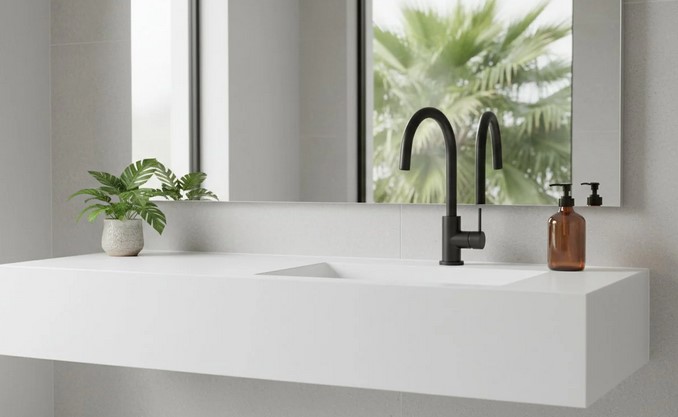
Matte Black: Offers a stunning industrial contrast against white porcelain, but requires more frequent wiping to prevent white calcium scaling.
-
Unlacquered Brass: A favorite for historic renovations; this finish is designed to oxidize over time, developing a unique, lived-in patina.
Technical Integration: Flow Rates and Valving
Let’s talk numbers for a moment. In the home improvement sector, we monitor water usage closely through Gallons Per Minute (GPM).
Expert Advice: Look for a bathroom sink faucet with a WaterSense label. These fixtures are engineered to maximize perceived water pressure while keeping the actual flow rate at or below 1.2 GPM.
They achieve this by introducing tiny air bubbles into the water stream via an integrated aerator. It feels like a luxurious torrent of water on your hands, but it cuts your water consumption by up to 32% compared to older 2.2 GPM models.
What the Showroom Won’t Tell You
The Wall-Mount Nightmare
Wall-mounted faucets look stunningly minimalist, but they come with a massive catch. The valve assembly must be installed inside the wall framing before the drywall and tiling go up. If that internal valve leaks or needs replacement ten years down the road, you will have to smash through your beautiful tile work to fix it. If you choose this path, always buy a premium commercial-grade valve with accessible front-facing shut-off stops.
-
Check the Drain Assembly: High-end faucets often include a matching pop-up drain assembly in the box. However, budget options frequently leave this out. Always verify if the drain mechanism matches your faucet finish before leaving the store.
-
The Flexibility Factor: Ensure your supply lines are flexible stainless steel braided hoses rather than rigid copper tubes. It will save you hours of frustration when trying to align the plumbing inside a cramped vanity cabinet.
Conclusion: Elevate Your Daily Ritual
Your bathroom sink faucet is touched dozens of times every day. It’s the very first thing you interact with when you wake up and the last thing you use before going to bed. By prioritizing proper geometry, opting for ceramic disc cartridges, and matching the right configuration to your lifestyle, you turn a simple plumbing utility into a design masterpiece.
Are you planning a bathroom refresh soon? What style of basin and faucet pairing are you imagining for your space? Let me know your design ideas or plumbing questions in the comments below, and let’s get your project flowing smoothly!