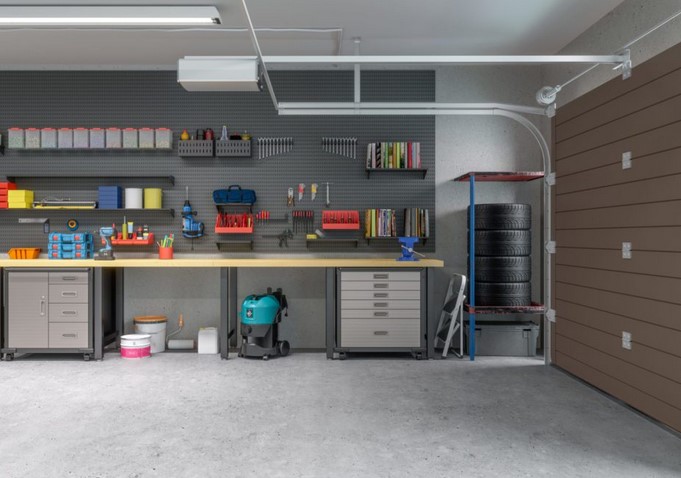
You’re twenty minutes into a simple brake pad change. Your hands are covered in grease, the car is up on jack stands, and you realize you need the 10mm socket. You check the workbench. Nothing. You check the plastic bin under the stairs. Not there. Before you know it, you’ve spent forty minutes hunting for a $5 tool, losing your daylight and your patience.
In my fifteen years of renovating residential workshops and managing high-stakes job sites, I’ve realized that a messy garage isn’t just an eyesore—it’s a massive drain on your productivity and safety. A high-quality Garage Tool Chest is the “central nervous system” of a functional home. Without it, you aren’t a craftsman; you’re just someone with a collection of expensive metal scattered across the floor.
I’ve seen beginners buy the cheapest, thinnest metal cabinets available, only to have the drawers sag and seize up after six months of holding heavy wrenches. Let’s talk about how to choose and organize a professional-grade hub that will last a lifetime.
The Engineering of Storage: Why a “Chest” Beats a “Box”
For the uninitiated, any metal box with drawers looks the same. But in the trade, we look for structural rigidity and weight distribution. A true Garage Tool Chest is designed to manage hundreds of pounds of high-density steel while remaining perfectly mobile.
Think of your tool chest like a high-rise apartment building. The foundation (the casters) has to support the weight of every floor above it. If the lower floors (the bottom drawers) aren’t built to handle the heavy appliances, the whole structure becomes unstable and dangerous.
Ball-Bearing Slides: The Silent Hero
One of the first technical specs I check is the drawer slide rating. Modern chests use ball-bearing slides rather than friction glides.
-
Static Load: How much the drawer holds while closed.
-
Dynamic Load: How much it can handle while you are pulling it open.
In my experience, you want a minimum rating of 100 lbs per drawer for a standard residential setup. If you’re storing heavy impact wrenches or hammers, look for double-slide configurations.
Strategic Layout: The “Frequent Flyer” Workflow
The biggest mistake I see in a Garage Tool Chest setup is poor “zoning.” Most people just toss tools where they fit. I prefer the Anatomical Organization method, which mimics how your body naturally reaches for things.
1. The Top Tier (The Cockpit)
This is usually a shallow area under a lid. This is for your most-used items: ratchets, screwdrivers, and pliers. You shouldn’t have to bend over or dig deep to find your primary drivers.
2. The Mid-Section (The Precision Zone)
Use the middle drawers for smaller, delicate items like hex keys, drill bits, and measuring tapes. I always recommend using foam shadow boards here. If a tool is missing, the empty “shadow” in the foam tells you exactly what you forgot to put away before you closed up for the night.
3. The Bottom Deep Drawers (The Heavy Artillery)
The largest, deepest drawers are at the base for a reason: low center of gravity. This is where your circular saws, angle grinders, and heavy mallets live. Storing these at the bottom prevents the chest from tipping over when you have multiple top drawers open.
Advanced Features: Beyond Just Metal Shelves
Modern workshop technology has turned the humble Garage Tool Chest into a powered workstation. When selecting yours, look for these LSI-relevant features that separate the amateurs from the pros:
-
Integrated Power Strips: Having USB ports and AC outlets built into the side of the chest allows you to charge your cordless drill batteries directly at the source.
-
Gas Struts: These allow the heavy top lid to open smoothly and stay open without slamming on your fingers—a lesson I learned the hard way in my third year of apprenticeship.
-
Central Locking Systems: If you have children in the house or expensive specialty tools, a single-key locking bar is a non-negotiable security feature.
[Image suggestion: A cross-section of a 42-inch tool chest showing internal drawer linings and ball-bearing rails]
Expert Advice: The “Hidden Warning” of Floor Loading
Here is a “Pro Tip” that most DIY blogs miss: Check your garage floor’s level and integrity. A fully loaded 52-inch Garage Tool Chest can easily weigh over 1,000 lbs. If your garage floor has a steep slope for drainage or cracks in the concrete, the tiny contact points of the casters can actually cause “pitting” or, worse, cause the chest to roll unexpectedly.
Maintenance for Lifelong Uptime
Metal-on-metal contact creates friction, and friction leads to rust and failure. Once a year, I perform a “Shop Audit” on my storage:
-
Vacuum the Tracks: Dust and metal shavings get into the grease of the ball-bearing slides, acting like sandpaper.
-
Lubrication: Use a dry PTFE spray or white lithium grease on the slides. Avoid WD-40 for this; it’s a degreaser, not a long-term lubricant, and it will actually attract more gunk over time.
-
Drawer Liners: Always use non-slip liners. They prevent your tools from sliding to the back every time you close the drawer, protecting the finish of both the tool and the chest.
Scannable Workshop Organization Checklist
-
Assess Your Inventory: Do you have more hand tools (shallow drawers) or power tools (deep drawers)?
-
Check the Gauge: Look for 18-gauge to 20-gauge steel construction. Anything thinner will “flex” under load.
-
Mobility Check: Does the chest have a sturdy side handle for steering?
-
Work Surface: Does the top have a wood or rubber mat? This allows the chest to double as a mobile assembly table.
-
Expandability: Can you add a “Side Locker” or a “Top Hutch” later as your collection grows?
Conclusion: Investing in Your Future Self
Organizing your garage isn’t just about tidiness; it’s about mental clarity. When you walk into your shop and see a professional Garage Tool Chest, your brain switches into “high-performance mode.” You stop searching and start building.
By choosing a chest with high-capacity slides, a low center of gravity, and a systematic drawer layout, you are setting the foundation for every project you’ll ever tackle. Don’t let your tools control you—give them a home that respects the work they do.
Is your current tool storage a single “junk drawer” or a scattered mess of plastic bins? What’s the one tool you can never seem to find when you need it? Let’s organize your workflow in the comments below!