It was 2:00 AM on a freezing stormy night when my emergency generator failed to kick on during a widespread neighborhood power outage. I scrambled down to the basement with a flashlight, expecting a major engine fault, only to find that the 12-volt starter battery had dropped to a useless 9.2 volts without warning. The battery looked visually pristine—no corrosion on the lead terminals, no bulging case—yet it was internally dead.
In my over ten years as a home improvement specialist and facility technician, I’ve seen that exact silent failure scenario ruin expensive backup systems, sump pumps, cordless power tools, and vehicles. People often assume a battery is working perfectly right up until the second it fails to deliver current.
Relying on simple visual checks or basic voltage multimeters is a recipe for sudden blackout disasters. Integrating a modern battery tester digital device into your maintenance toolkit allows you to read internal resistance, conductance, and true state-of-health (SoH) before an emergency leaves you stranded in the dark.
Electrochemical Physics: Why Standard Voltage Meters Lie to You
To understand why traditional diagnostic methods fail, you have to look at how chemical energy converts into electrical flow inside a cell. A standard multimeter measures open-circuit voltage (OCV)—the electrical pressure standing at the terminals when no current is being drawn.
Think of a chemical battery like an elevated water tower connected to a house through a pipe. A simple voltmeter only checks how high the water level sits in the tank. A battery tester digital unit acts like opening the main fire valve, measuring both the water pressure and how wide open the pipe actually is (internal resistance).
                                [ BATTERY TESTER DIGITAL ]
                                            ||
                     +----------------------+----------------------+
                     |                                             |
     [ Open-Circuit Voltage (OCV) ]                [ Conductance / Internal Resistance ]
 - Measures surface voltage potential            - Applies micro-frequency AC load signal
 - Shows "12.6V" even on degraded cells          - Detects internal plate sulfation
 - Fails to predict high-current delivery        - Calculates actual State of Health (SoH)
As lead-acid or lithium-ion batteries age, lead sulfate crystals build up on the internal plates (sulfation) or electrolyte fluids break down. This increases internal resistance ($R_i$), which acts like a clog in the pipe:
-
Surface Charge Illusion: A heavily sulfated battery can rest at a healthy-looking 12.6 volts, yet collapse down to 6.0 volts the millisecond a starter motor pulls a heavy electrical load.
-
AC Conductance Testing: Modern digital analyzers send a low-frequency alternating current signal through the cell matrix to measure true conductance without draining or damaging the battery.
-
State of Health (SoH) vs. State of Charge (SoC): State of Charge tells you how full the battery is right now; State of Health tells you how much total storage capacity remains compared to when it was brand new.
Selecting the Right Digital Testing Hardware
Not all battery testing tools perform the same diagnostic functions. Choosing the correct tester profile depends on whether you are maintaining small household cells, high-draw power tool packs, or heavy lead-acid starting batteries.
| Tester Type | Primary Test Method | Best Battery Chemistries | Ideal Application |
| Conductance Digital Analyzer | Micro-load AC frequency pass | Lead-Acid (AGM, Gel, Flooded) | Automotive, standby generators, solar banks, sump pumps |
| Dynamic Carbon-Pile Tester | Heavy resistance heat-sink load | Heavy Flooded Lead-Acid | Commercial vehicles, high-CCA tractor batteries |
| Lithium-Ion Smart Meter | Pulse-discharge internal resistance | LiFePO4, Li-ion, NiMH | Cordless power tools, home energy storage, electronics |
1. Digital Conductance Analyzers
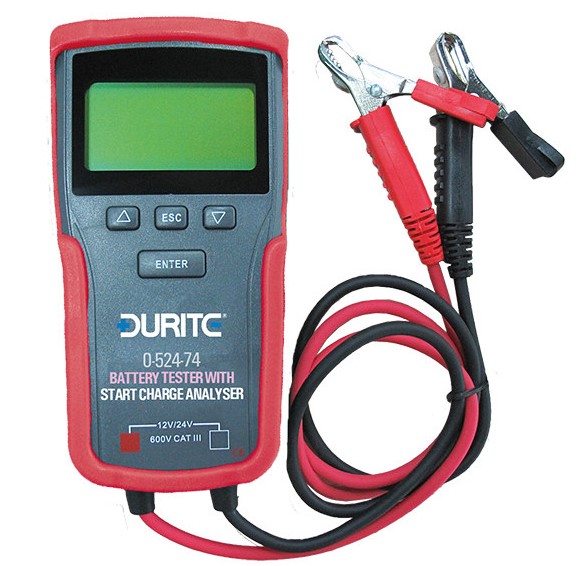
These lightweight, handheld digital units clip directly onto terminal posts and process algorithms in seconds without generating dangerous heat.
-
Best used for: Home standby power generators, riding mowers, marine deep-cycle setups, and automotive AGM batteries.
-
Key feature to look for: Input programming for multiple rating standards, including CCA (Cold Cranking Amps), Ah (Amp-Hours), IEC, and EN rating scales.
2. Multi-Chemistry Smart Diagnostics
Advanced digital units feature customized software profiles designed specifically for lithium iron phosphate ($\text{LiFePO}_4$) and traditional lithium-ion chemistries.
-
Best used for: High-end cordless tool batteries, portable solar generator stations, and backup power banks.
Step-by-Step Diagnostic Protocol: Executing an Accurate Test
Getting laboratory-accurate data from a battery tester digital unit requires a strict testing sequence to eliminate surface charge interference and loose contact readings.
Step 1: Dissipate the Surface Charge
If a lead-acid battery was recently charged or the vehicle alternator was running within the last hour, it will display an artificially high surface voltage. Turn on a headlamp or connected 12V accessory load for two minutes, then turn it off and let the battery rest for five minutes before testing.
Step 2: Establish Low-Resistance Clamp Contact
Connect the red positive clamp directly to the positive lead post, followed by the black negative clamp to the negative post. Ensure the jaw teeth bite through grease, oxidation, or dirt to touch bright, bare metal—high contact resistance will skew your digital internal resistance reading!
Step 3: Input Baseline Battery Ratings
Navigate your analyzer menu to select the battery chemistry (e.g., AGM Flat Plate, Flooded, Gel) and enter the exact factory rating stamped on the label (e.g., $600\text{ CCA}$ or $100\text{ Ah}$). The analyzer will run its algorithms and display the measured CCA, internal resistance in milliohms ($\text{m}\Omega$), and overall State of Health percentage.
[ Step 1: Clear Surface Charge ]      [ Step 2: Input Factory CCA ]
  Rest battery or apply 2-min load      Program baseline specs into menu
+----------------------------------+  +----------------------------------+
| Remove surface voltage spikes    |==| Match label ratings for precise  |
| Ensure stable resting potential  |  | State-of-Health (SoH) calculations|
+----------------------------------+  +----------------------------------+
Pro Tips & Hidden Warnings
Pro Tip: Establish Baseline Records for New Batteries
The moment you purchase a new battery for your backup generator, vehicle, or solar bank, run a diagnostic scan with your battery tester digital unit. Write down the initial internal resistance reading ($\text{m}\Omega$) directly on the battery case with a permanent marker. When you re-test every six months, a $20\%$ or higher increase in internal resistance signals that the battery is entering internal degradation, long before it fails completely!
The Temperature Compensation Fallacy
Chemical activity inside batteries slows down drastically in freezing conditions, causing internal resistance to spike naturally. If you test an outdoor battery at $20^\circ\text{F}$ ($-6^\circ\text{C}$), an uncompensated digital tester may report a false “Replace Battery” warning. Always let cold batteries warm up to room temperature ($68^\circ\text{F}\text{–}72^\circ\text{F}$ / $20^\circ\text{C}\text{–}22^\circ\text{C}$) before making a final disposal or replacement decision!
Ensuring Uninterrupted Power Readiness
Maintaining your home’s mechanical and electrical systems isn’t about waiting for things to break—it’s about predictive maintenance. Adding an accurate, handheld battery tester digital analyzer to your diagnostic setup replaces guesswork with precise scientific telemetry, guaranteeing that your backup power sources deliver performance when you need them most.
How do you currently test and maintain the critical backup batteries in your home, workshop, or vehicles? Have you ever been caught off guard by a sudden battery failure during a power outage or project? Drop your thoughts, questions, and setup experiences in the comments below—I’d love to help you optimize your power readiness!