It is 3:00 AM. A window shatters downstairs, and your adrenaline spikes so hard you can hear your own heartbeat in your ears. In this moment, fine motor skills disappear. You reach for your bedside cabinet, but your shaking hands fumble with a tiny key, or your brain—fogged by sleep—completely forgets a four-digit combination you’ve known for years. Every second feels like an eternity. This isn’t just a dramatic “what-if”; it is the exact scenario where traditional security often fails the homeowner.
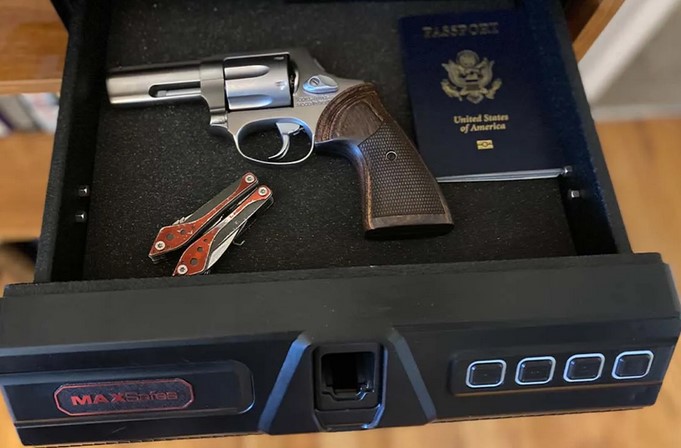
In my decade of installing high-security home fixtures and consulting on “hardened” residential design, I’ve seen the evolution of home defense firsthand. I’ve moved clients away from the “hidden key” method (which burglars find in minutes) toward a more sophisticated, failsafe approach. The centerpiece of a modern, responsive home security strategy is the Gun Safe Biometric system. It turns your unique biological signature into the only key you will ever need.
The Evolution of Access: Why Biometrics Win
When we talk about a Gun Safe Biometric system, we are moving from “something you have” (a key) or “something you know” (a code) to “something you are.” In the high-stakes world of firearm safety, “knowing” can fail under stress, and “having” can be lost or stolen.
I remember a project three years ago for a veteran who had a massive collection of antique mechanical safes. They were beautiful, but he admitted he never used them because they were too cumbersome. We switched his primary quick-access safe to a biometric model, and the relief on his face was palpable. He finally had security that didn’t feel like a barrier.
The Smartphone Analogy
Think of a Gun Safe Biometric lock like the fingerprint scanner on your smartphone. You don’t think about “logging in” anymore; you just touch the button and the device is ready. A biometric safe applies that same seamless “frictionless” logic to your most sensitive assets. It removes the cognitive load of a crisis, allowing the machine to do the heavy lifting of identification.
The Technical Anatomy of a Biometric Scanner
Not all scanners are created equal. If you are looking to implement a Gun Safe Biometric solution, you need to understand the difference between the “cheap plastic” versions and the “security-grade” hardware.
1. Optical vs. Capacitive Sensors
Most entry-level safes use optical scanners (essentially a camera taking a picture of your finger). In my experience, these are prone to failure if your hands are sweaty or if the glass is smudged.
-
Capacitive Sensors: These use electrical currents to map the ridges of your fingerprint. They are significantly more secure and much faster.
-
Thermal Scanners: These map the heat signature of your finger, making it nearly impossible to “spoof” with a fake print or a photo.
2. False Rejection Rate (FRR)
This is the most critical technical spec. The FRR tells you how often the safe will reject a “correct” finger. In a home improvement context, we look for an FRR of less than 0.1%. A safe that doesn’t open on the first try is just an expensive paperweight during an emergency.
3. Non-Volatile Memory
Ensure your safe has non-volatile memory. This means that even if the batteries die completely, the safe “remembers” your fingerprints. I once had a client panic during a battery change, thinking they were locked out forever. A professional-grade system keeps your biological data stored in a chip that doesn’t require power to retain information.
Strategic Logistics: Placement and Installation
A safe is only as secure as its mounting. I’ve seen $2,000 safes carried out of a house because they were just sitting on a shelf. To truly protect your assets, you must treat the installation as a structural project.
-
Anchor Bolts are Mandatory: Use 3-inch sleeve anchors to bolt the safe directly to the concrete slab or the wall studs.
-
The “Shadow” Placement: Don’t put your Gun Safe Biometric in plain sight. I prefer “stealth” locations—inside a custom-built nightstand or recessed into a wall behind a hinged mirror.
-
Reachability vs. Concealment: For a primary home defense tool, the safe should be accessible within a two-second reach from your sleeping position.
Expert Advice: The “Multi-Finger” Protocol
Most homeowners register only their primary thumb. This is a tactical mistake I see constantly.
Tips Pro: When you set up your Gun Safe Biometric, register at least four fingers: both thumbs and both index fingers. Why? Because if you injure your dominant hand, or if you are forced to reach for the safe from an awkward angle, you need redundant access. I also recommend scanning each finger at three different angles (straight on, left-tilt, right-tilt) during the setup phase to increase the “read” accuracy.
The Battery Trap: Biometric scanners are power-hungry compared to a simple mechanical dial. Cheap alkaline batteries can leak and ruin the circuit board. Always use high-performance Lithium batteries. They have a longer shelf life and won’t corrode the sensitive electronics of your safe’s brain.
Maintaining Your Biometric Infrastructure
A Gun Safe Biometric system is a piece of high-precision equipment. It requires a “logistical check-up” twice a year—I usually tell my clients to do this when they change their smoke detector batteries.
-
Sensor Cleaning: Use a microfiber cloth and a tiny drop of rubbing alcohol to clean the scanner glass. Skin oils can build up and create “latent prints” that slow down the scanning process.
-
The “Key” Backup: Every biometric safe comes with a physical override key. Do not store this key inside the safe (yes, people do this). Hide it in a high-quality lockbox at a secondary location or give it to a trusted family member.
-
Software Updates: Some high-end “smart” safes now offer firmware updates via USB. These updates often improve the fingerprint recognition algorithms.
Summary: Speed Meets Security
Implementing a Gun Safe Biometric system isn’t just about following a tech trend; it’s about optimizing the “human-to-tool” interface. By removing the mechanical and cognitive barriers of keys and codes, you are creating a home defense strategy that is both faster and more secure.
In my decade of experience, the transition to biometrics is the single most significant “peace of mind” upgrade a homeowner can make. It ensures that when the “drip” of the rain turns into the “shatter” of a break-in, you are the only one who can access your protection, and you can do it in the blink of an eye.
Are you still relying on a hidden key that your kids might find, or are you ready to turn your fingerprint into your ultimate security clearance? If you’re wondering which sensor type fits your specific environment, drop a comment below—let’s make sure your family is protected by the best tech available!